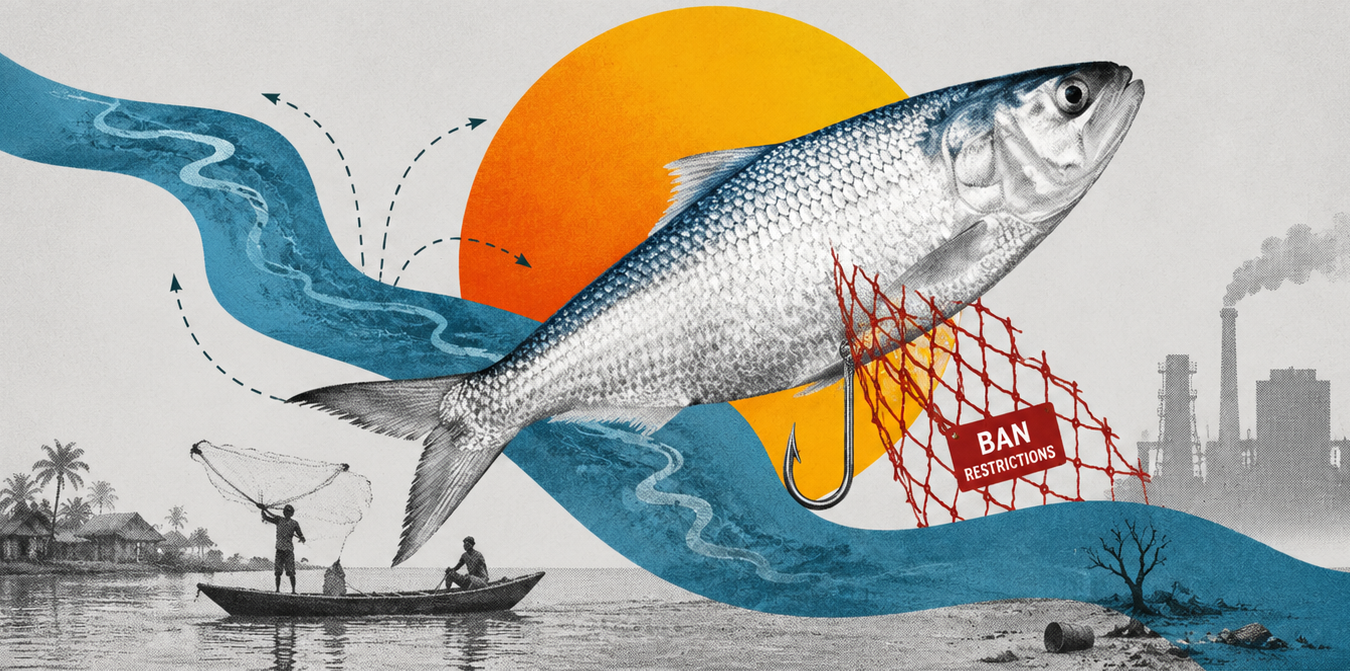
The Future of Hilsa in a Warming Bangladesh
Hilsa, the national fish of Bangladesh, is not only a fish in the very land of Bangladesh, but it is also a tradition, celebration, and identity. Whether it’s a Pahela


Hilsa, the national fish of Bangladesh, is not only a fish in the very land of Bangladesh, but it is also a tradition, celebration, and identity. Whether it’s a Pahela Baishakh table or a monsoon market, ilish (Hilsa) has more to its monetary value than it does to its cultural significance. Its silver body carries the smell of rivers, rain, and Bengali tradition. For many Bangladeshis, Ilish (Hilsa) is less a dish than an emotion, and when it comes to taste, it sits proudly at the head of the table. The numbers tell you why Hilsa is
important economically as well. The Department of Fisheries’ Yearbook of Fisheries Statistics of Bangladesh 2023–24 records Hilsa as the country’s largest single-species fishery. From the same sources, it is estimated that Hilsa fish production is approximately 12% of the total fish production of the country, and the production in 2023-24 is about 5.29 million metric tonnes with an estimated market value of BDT 20680 crore. A 2026 statement from the fisheries ministry reported that Hilsa contributes about 9.79% of national fish production and about 1% of GDP, while around six lakh people are directly engaged in Hilsa production and 20–25 lakh more are linked through transport, trading, boat-making, ice, processing and export.
But the future of this national fish is becoming less certain. Hilsa are migratory: they move between the Bay of Bengal, estuaries, and rivers to complete their life cycle. Scientific work on Hilsa spawning has already shown that production patterns have shifted, with inland catches declining while marine catches increased, and major spawning areas moving towards lower estuarine regions such as Hatia, Sandwip, and Bhola. Climate change adds more pressure through warmer water, salinity intrusion, erratic rainfall, and changing river flow. Pollution, siltation and overfishing make that pressure sharper.
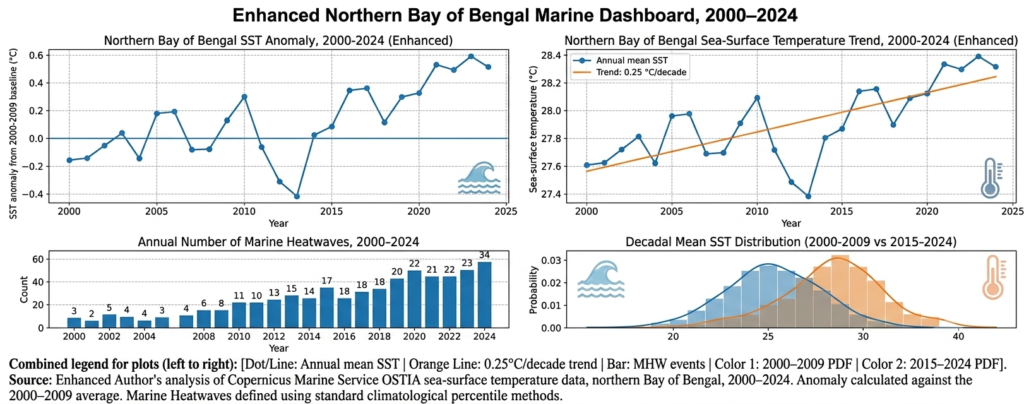
This is where our Copernicus Marine visualisation becomes important. The graph uses sea-surface temperature data from the northern Bay of Bengal, covering 88°E–93°E and 18°N–23°N, near Bangladesh’s coastal Hilsa migration zone. The anomaly is calculated relative to the 2000–2009 average (baseline), meaning recent years are compared with the early part of the dataset. The result shows a clear warming tendency from 2000 to 2024, with an estimated trend of about 0.25°C per decade. The graph should not be read as proof that warming alone is reducing Hilsa. Fish populations are never shaped by one factor only. But it is a serious warning signal. Hilsa do not belong only to the river or only to the sea; they depend on the estuarine ecosystem. Warmer coastal waters may affect migration timing, food availability, breeding behaviour, and physiological stress. When this marine warming combines with saltier estuaries, polluted rivers, and weaker freshwater flow, the migration corridor becomes less stable. In a warming Bangladesh, Hilsa are swimming through a changing map. Recent research supports this wider
concern. A 2015 study on climatic and human pressures found that Hilsa spawning grounds have shifted towards lower estuarine areas, while a 2023 Frontiers in Marine Science study on small-
scale Hilsa fishers described coastal fishing communities as vulnerable to climate change and in need of social, economic and ecological adaptation.Research on Bangladesh’s urban rivers shows a troubling pattern: industrial effluents, chemical discharges, and household waste are steadily degrading the water quality of major rivers such as the Buriganga, Turag, Balu, Sitalakhya, and Karnaphuli. In the dry season, oxygen levels in some of these rivers drop to dangerously low levels, placing aquatic life and surrounding communities at serious risk.
Bangladesh is not lacking in policy frameworks. The government has used Hilsa sanctuaries, jatka protection, brood Hilsa bans, and seasonal fishing restrictions. The ministry has listed a 58- day ban on all fishing in the Bay of Bengal, a 22-day breeding-season Hilsa ban, and a prohibition on jatka catching, transport and sale from 1 November to 30 June. These rules are essential, but research by World Fish shows that bans can also reduce fisher income and increase indebtedness if compensation and alternative livelihoods are weak. Such policies are relevant but need to be implemented fairly and adequately supported for fishers throughout the ban. The solution, therefore, cannot be only policing. Bangladesh needs climate-smart Hilsa management: stronger pollution control, protection of spawning and nursery grounds, real-time monitoring of temperature, salinity, and migration, and fair food or cash support during ban periods. WorldFish’s ECOFISH experience suggests that community co-management, women’s savings groups and alternative income activities can make conservation more acceptable and effective when fishers are treated as partners rather than offenders. Hilsa has always followed the rhythm of tide, river, and season. But that rhythm is changing. If Bangladesh protects only the fish but not the rivers, only the ban but not the fisher, only the market but not the migration route, the silver icon may slowly slip away. Saving Hilsa is not nostalgia. It is climate policy, river policy, and cultural survival in one net.